Voxago
Ten products, eleven industries, one telephony brand
- Industry
- Telephony, SaaS
- Year
- 2023 — ongoing
- What we did
- Marketing platform design & development, technical SEO
- Live
- voxago.com
- Site languages
- EN
- Public pages
- 73
- Industry pages
- 11
- Integration pages
- 26
Overview
Voxago is a US business-telephony brand: phone system, contact center, SMS, fax, meetings and AI voice agents under one subscription. We designed and built its site on Next.js 16 — 73 pages covering ten products, eleven industries and 26 integrations, with pricing and compliance laid out in full. It replaces the first version, a single-page React app on Laravel from 2023. In November 2026 the homepage and seven product pages were redesigned around a live demo of the product itself.
- Integrations26
- Industries11
- Products10
- Use cases6
- Company sizes4
01 — Challenge
Voxago sells ten products to buyers as different as a dental clinic and a law firm, and each of them has to find their own case fast. The first site was a single-page app that answered every URL with the same empty HTML shell, leaving search engines and link previews nothing to read. And telephony buyers compare prices and compliance long before they book a demo.
02 — What we built
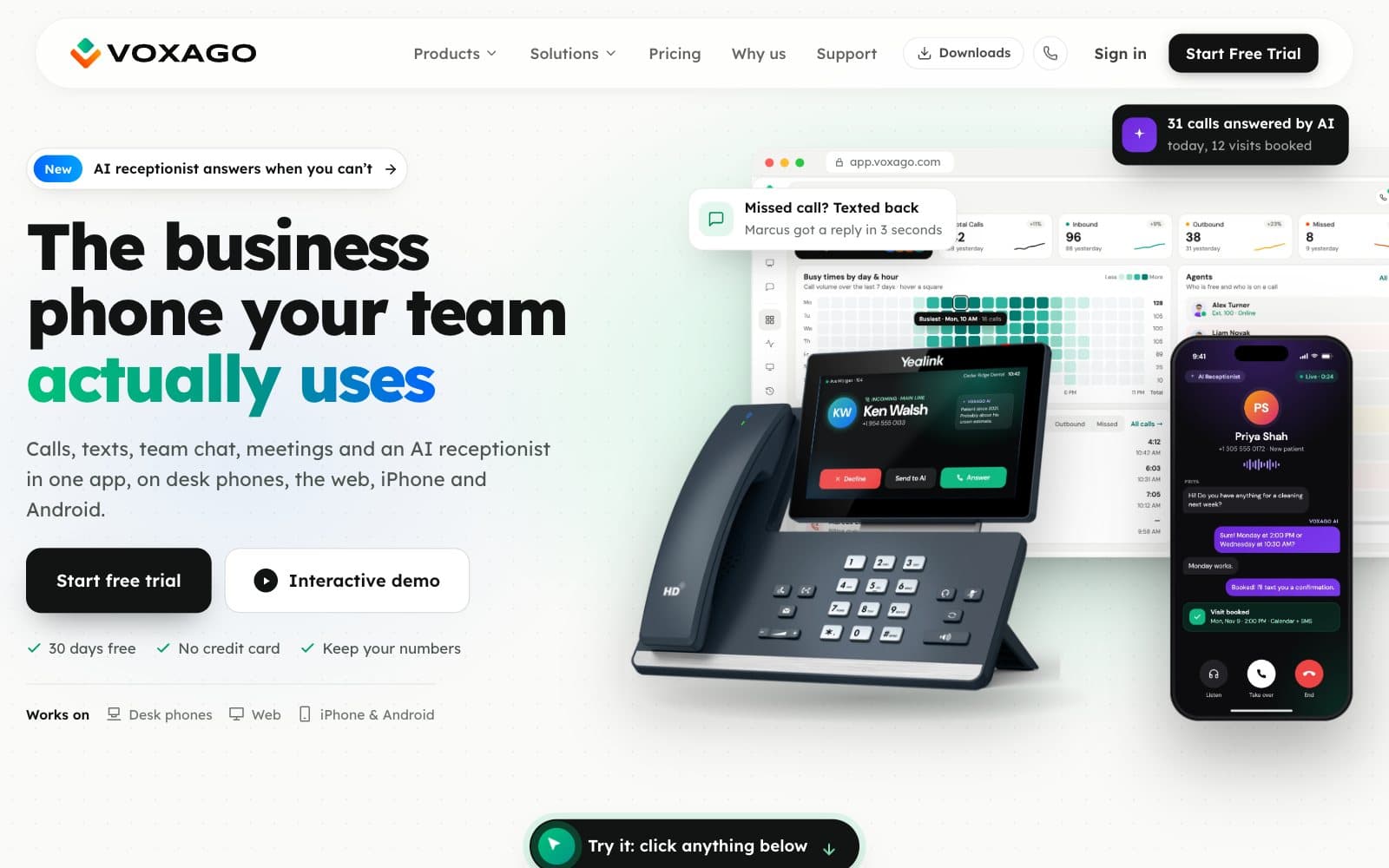
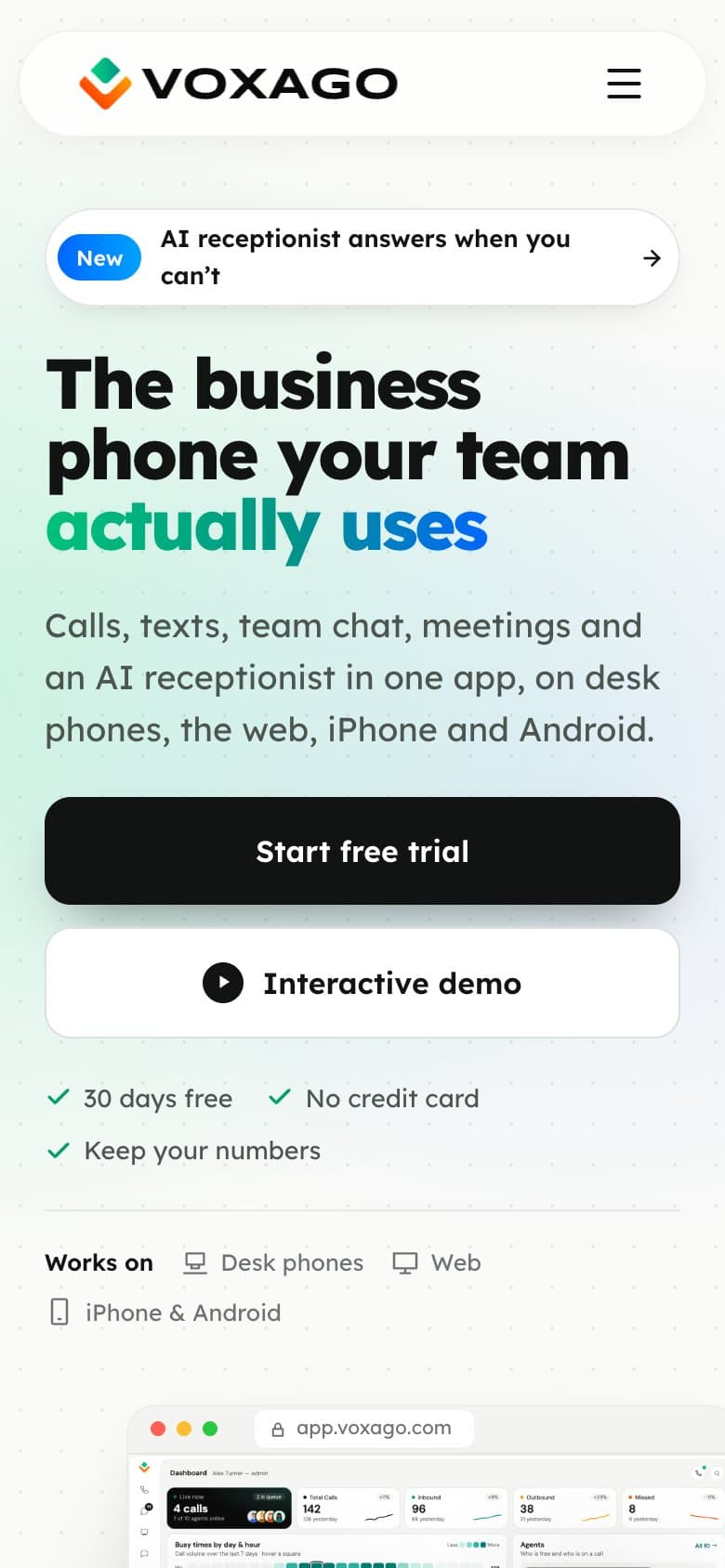
We rebuilt the site on Next.js 16 with React 19 server components and a typed content layer: products, solutions, industries, integrations, plans and compliance frameworks live in data files that every template reads. Pages are prerendered at build time, each with its own metadata, canonical URL and structured data. Features are illustrated with small coded interface mock-ups instead of stock photography. The homepage now opens on a desk phone, the web app and the mobile app side by side, and lets a visitor click through the product before signing up.
03 — Result
A 73-page site where every product, industry and integration has its own URL. Pricing is public — three plans from $19.95 per user and a 42-row comparison — and five compliance frameworks are documented in one hub. Trial, support and integration requests land in the team's Telegram the moment they are sent.
A homepage you can click
Right under the hero sits the product: the web app and the mobile app, filled with made-up data and open without sign-up. Ten tabs work for real — answer the ringing call, hover the busy-hours heatmap, run a test call through the IVR, read an AI summary of a recording.
- Web app and mobile app, one click apart
- Ten working tabs, from softphone and texting to wallboard and call flows
- Loads after the page, so the first screen does not wait for it
One app instead of five
A buyer usually comes from five separate tools: a phone system, a texting app, team chat, video calls and contact-center software. The homepage lays all 24 features out in one grid and filters it by those jobs, then a dark panel and an Ask AI block show how they work together.
- 24 features filtered by calling, messaging, meetings, contact center and AI
- Ten products in the menu, grouped Connect, Collaborate, Automate
- Ask AI block: a typed answer about yesterday’s calls, with sources
Product pages
Seven product pages — phone system, contact center, SMS, fax, meetings, team chat and the desktop and mobile apps — were redrawn with their own hero art and a plain walk-through of how the product works. Six of them end in the same live demo, opened on their own tab: the contact center page lands on live calls, meetings on a running call.
- Seven redesigned pages with their own hero art
- The live demo opens on the page’s own tab
- Industry, compliance and AI pages keep their templates
Pricing
Basic, Pro and Executive — $19.95, $24.95 and $29.95 per user a month — sit above a 42-row comparison, so a buyer sees exactly what the next tier adds. The cards and the matrix read from one plan file, so they cannot drift apart.
- Three per-user plans, free trial, no credit card required
- 42 features compared across Basic, Pro and Executive
- AI voice agents priced apart, from $39 per agent a month
Key decisions
- The live demo is the app’s screens rebuilt as React components with made-up data; it loads after the page and is reused by six product pages.
- 72 of 73 pages are prerendered at build time, each with its own title, canonical URL and Open Graph tags.
- Plans, FAQs, integrations and legal pages are read through small repositories over typed files shaped like the CMS's public API, so moving them into the admin means swapping one loader each.
- 139 coded interface mock-ups illustrate features in place of stock screenshots, so they stay sharp at any size.
- The SMS/MMS relay verifies signed carrier webhooks, drops duplicates and serves attachments through expiring sealed links.